

As a CNC Swiss turned parts supplier, I'm often asked a deceptively simple question by engineers, procurement managers, and hobbyists alike: "What's the maximum diameter of parts you can produce on Swiss-style machines?" It's a question that might seem to have a straightforward numerical answer, but the reality is far more nuanced-one that depends on a mix of machine technology, part complexity, material type, tooling, and even the specific tolerances required for your project. Over 12 years of running our precision machining shop, I've worked with parts ranging from 0.5mm medical implants to 40mm automotive components, and I've learned that the "maximum diameter" is less a hard limit and more a balance between what a Swiss machine is designed to do and what your part actually needs.
To start, let's ground this in how Swiss-style turning works, because that's the root of the diameter limit distinction. Unlike conventional lathes, where the workpiece is held in a chuck and extends out from the machine, Swiss machines use a guide bushing that clamps the raw material very close to the cutting tool. This support eliminates the deflection that plagues long, thin parts on standard lathes, allowing for extreme precision on small-diameter work. But that guide bushing setup also directly dictates the upper range of diameters a given machine can handle-because the bushing's inner size is tailored to a specific range of bar stock.
Most entry-level Swiss machines, often used for small, high-volume parts like fasteners or electronic connectors, have maximum bar stock capacities between 16mm and 32mm. These are workhorses for industries like consumer electronics, where parts are tiny and tight tolerances (±0.005mm, for example) are non-negotiable. But if you're looking for larger parts, like high-precision automotive spindles or small medical implants, you'll need a next-generation Swiss machine built to accommodate bigger bar stock. Our shop invests in 5-axis Swiss lathes with bar capacities up to 40mm diameter, and even larger CNC Swiss models paired with bar feeders that can handle raw stock up to 65mm in some configurations. That said, once you push past 40mm, you start to blur the line between Swiss turning and other CNC turning processes. Traditional Swiss designs prioritize rigidity for slender workpieces, so for parts over 50mm, many shops will recommend a multi-axis turning center instead-but that doesn't mean Swiss-style machines are entirely off the table for larger components.
What changes as diameter increases? Let's break down the key factors that shift the maximum usable diameter, because it's not just about the machine's bar capacity. First, material type is huge. Soft, ductile materials like aluminum or brass are far easier to machine at larger diameters than hard metals like titanium or stainless steel. When you're turning a 60mm diameter bar of titanium, the cutting tool experiences much higher forces, which can cause deflection even with a guide bushing if the diameter is near the machine's upper limit. We regularly produce hard anodized aluminum Swiss turned parts up to 40mm diameter for aerospace applications, but hard anodizing adds a thin, hard coating that can slightly increase tool wear at larger sizes. For materials like steel, the sweet spot for Swiss turning is generally between 10mm and 40mm; beyond that, the feed rates drop too much to be cost-effective for high-volume production.
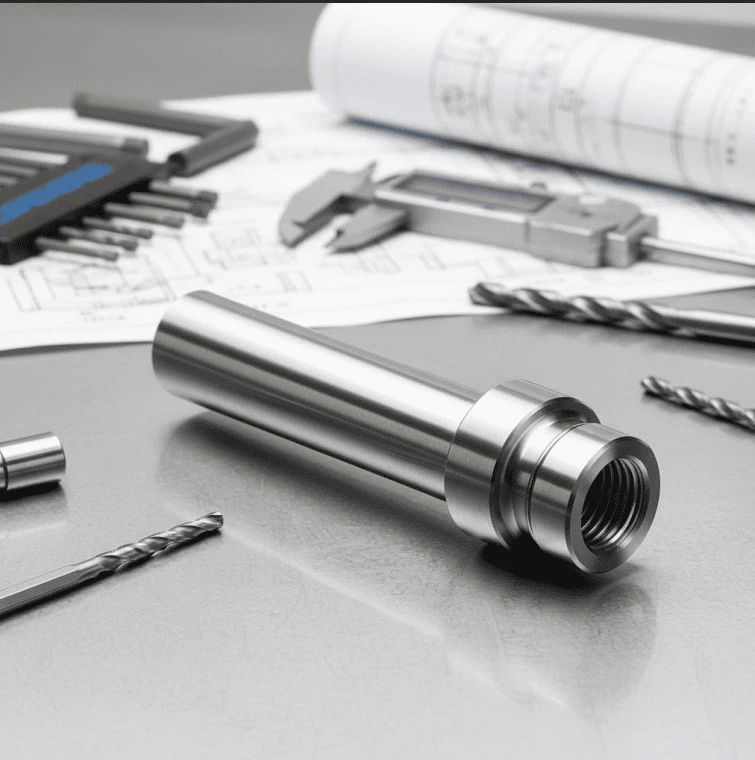
Part complexity is another critical factor. If you need a simple straight shaft with a few threads, a Swiss machine can handle a 40mm diameter part with no problem. But if you're adding multiple cross-drilled holes, off-center features, or tight-tolerance tapers, that puts extra load on the machine's spindle and guide bushing. We recently worked on an automotive fastener that was 38mm in diameter with 12 cross holes drilled at 90-degree angles-because of the complexity, we had to stick to our mid-size Swiss machine to maintain alignment, and even then, we adjusted our tooling to reduce vibration. For even more complex parts, like custom forged shaft blanks that need multiple milling and turning operations, the maximum diameter drops to around 35mm, because the additional operations require more spindle power and rigidity that's harder to achieve at the edge of a Swiss machine's capacity.
Tooling technology has also expanded the maximum diameter range for Swiss turning over the last decade. Modern Swiss lathes come with advanced tool holders that can accommodate larger cutting tools, which means you don't have to compromise on surface finish when machining bigger parts. Ten years ago, a 40mm diameter Swiss turned part would have had a rougher surface finish (around Ra 1.6) than a conventional turned part, but today's coated carbide tools and high-pressure coolant systems can get Swiss-machined surface finishes down to Ra 0.8 at that size-matching or beating conventional processes. That's why more engineers are turning to Swiss machines for parts in the 30-40mm range, even when they could use a conventional lathe, because of the precision and consistency Swiss turning delivers for long production runs.
It's also important to address common misconceptions about maximum diameter. Some people assume that Swiss machines can only make small parts, but that's outdated. Our shop's largest Swiss-machined part to date is a 58mm diameter medical tool component, produced on a custom Swiss lathe modified to handle bar stock up to 65mm. That part was a straight shaft with a few grooves and a threaded end, and it came out with a total runout of less than 0.01mm-something a conventional lathe would have struggled to achieve, even with the same material and tolerance. The key there was that the part's length was only 120mm, so the bar didn't have to extend far past the guide bushing, minimizing deflection. If that same part was 300mm long, we would have capped the diameter at 40mm, because longer parts at larger diameters are more prone to bending under machining forces.
So, where is the practical maximum for most shops? For standard Swiss-style machines (the ones most job shops use, with bar capacities up to 65mm), the sweet spot for high-quality, cost-effective production is between 2mm and 40mm. Parts between 40mm and 65mm are possible, but they require specialized equipment and careful process planning, with trade-offs in speed or complexity. Parts over 65mm are rarely produced on Swiss machines, because you can get better rigidity and faster production from a multi-axis turning center or mill-turn machine that doesn't rely on a guide bushing.
But here's the thing: the "maximum diameter" is always flexible if you're willing to adjust your part design. For example, if you need a part that's 50mm in diameter, but you can split it into two smaller components (say, 25mm and 35mm) that assemble to the final size, you can get the precision of Swiss turning for each part, rather than settling for a less precise conventional turning process. We've done this for several clients in the electronics industry, where parts that would be too big for standard Swiss machines are split into two CNC electronic enclosures components that snap together or fasten with custom manganese phosphate screws. That approach not only keeps production costs lower but also maintains the tight tolerances Swiss turning is known for.
As a supplier, I always start with two questions when a client asks about maximum diameter: What's your part's material, and what's its required length and tolerance? A 50mm diameter brass part that's 100mm long is entirely feasible on a modified Swiss machine, while a 45mm diameter titanium part that's 200mm long is going to push the limits of even our largest equipment. I've had clients come to us with a part they tried to machine on a conventional lathe, only to find they needed Swiss turning's precision once they realized their 35mm diameter part had a runout error of 0.1mm, which was too much for their application. That's the value of Swiss turning beyond just diameter size-it's about the precision that comes with the guide bushing support.
If you're working on a new project and wondering whether Swiss turning is right for your part, don't get hung up on the maximum diameter number. The best way to find out is to send us your CAD file, your material specs, and your tolerance requirements, and our engineering team can run a quick feasibility check. We've machined parts for industries ranging from aerospace to medical, and we've helped dozens of clients adjust their part designs to fit within the optimal Swiss turning range without sacrificing functionality. Whether you need a tiny 1mm medical pin or a 40mm automotive shaft, we have the machines and expertise to deliver consistent, high-quality Swiss turned parts.
If you're ready to discuss your project, or have questions about how Swiss turning can work for your specific diameter and part needs, don't hesitate to reach out to our team for a no-obligation consultation. We're here to help you find the best manufacturing solution, whether that's Swiss turning or another CNC process, and we look forward to collaborating on your next precision part.
References
- Machining Science and Engineering, Volume 12, 2021: "Advances in Swiss-Style Turning for Precision Medical Components"
- Modern Machine Shop, 2022: "Maximizing Swiss Lathe Performance for Medium-Diameter Parts"
- SME International, 2020: "Material and Process Trade-Offs in High-Precision Turning Operations"
- Aerospace Manufacturing and Design, 2023: "Guidelines for Swiss Turning of Aerospace Grade Aluminum and Titanium Alloys"
- Automotive Engineering International, 2021: "Precision Fastener Production: The Role of Swiss Turning in Automotive Supply Chains"