

Customized Prototyping Service
Surface finishing is a critical step in CNC machining that improves part appearance, durability, corrosion resistance, wear resistance, and overall performance. By applying the right finishing process after machining, manufacturers can achieve better surface quality, tighter functional performance, and improved product lifespan.
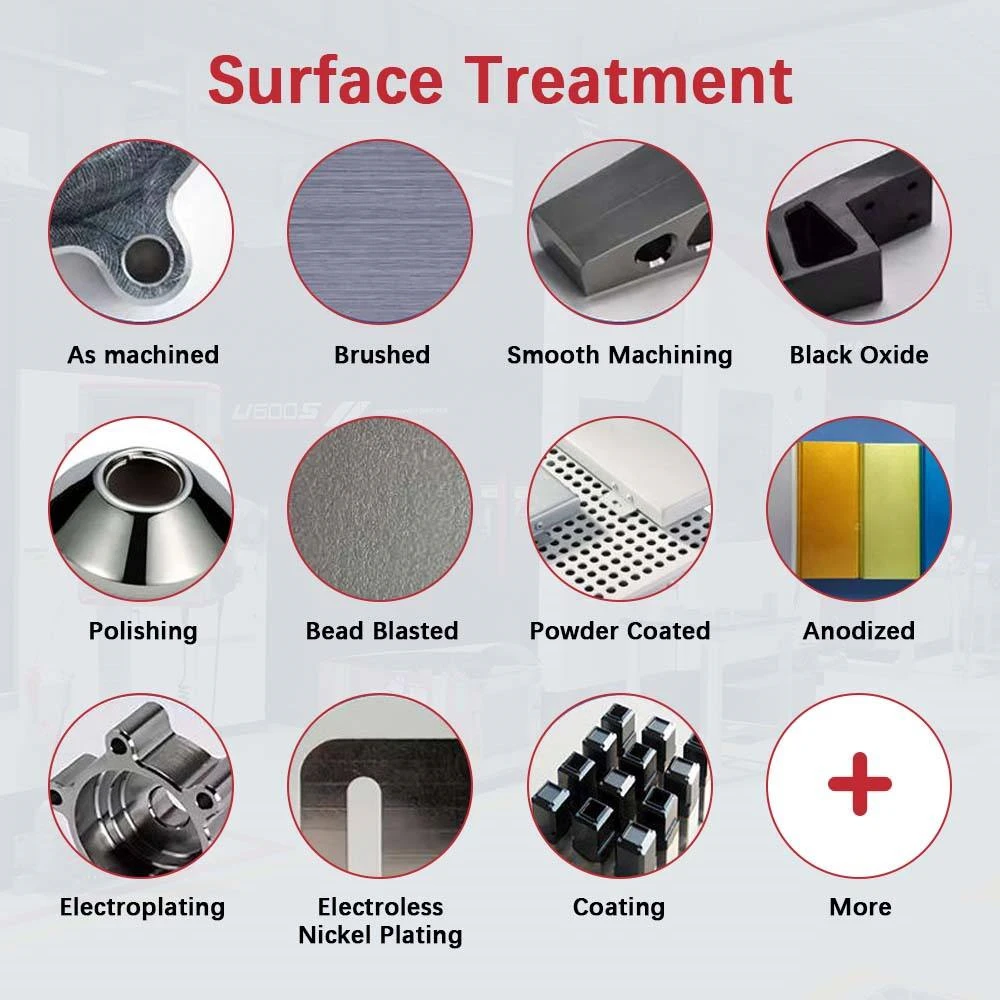
We provide a wide range of CNC machining surface finishing options for aluminum, stainless steel, titanium, brass, copper, and engineering plastics, including anodizing, powder coating, electroplating, bead blasting, polishing, passivation, and heat treatment.
Whether you need prototypes, precision components, or production parts, our finishing solutions help transform machined parts into ready-to-use industrial components.


What Is Surface Finishing in CNC Machining?
CNC machining surface finishing refers to the secondary processes applied after milling, turning, or grinding to improve the surface characteristics of machined parts. These treatments modify the outer layer of a component to achieve specific requirements such as:
- Improved appearance
- Increased corrosion resistance
- Enhanced wear resistance
- Reduced surface roughness
- Better dimensional stability
- Improved electrical or thermal properties

Why Choose Our CNC Surface Finishing Services?
We provide complete CNC machining and finishing solutions including:
✓ CNC Milling
✓ CNC Turning
✓ 5-Axis Machining
✓ Anodizing
✓ Powder Coating
✓ Plating
✓ Polishing
✓ Passivation
Surface Finishing Selection by CNC Machining Process
- CNC Milling Surface Finishes
- CNC Turning Surface Finishes
- 5-Axis CNC Machining Surface Finishes
-
 CNC Milling Surface Finishes
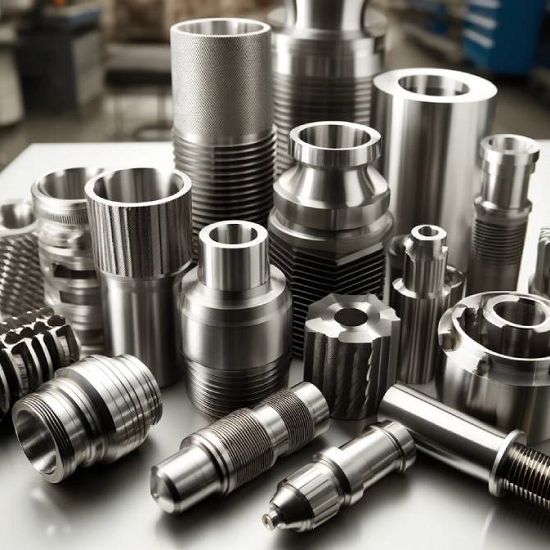
CNC milling produces flat surfaces, pockets, slots, and complex geometries.
Recommended finishes:
Requirement
Recommended Finish
Improve appearance
Bead blasting + anodizing
Reduce machining marks
Brushing
Increase corrosion resistance
Anodizing / plating
Precision mechanical parts
Polishing
Common applications:
•Aerospace brackets
•Aluminum housings
•Mechanical components
-
 CNC Turning Surface Finishes
CNC turning creates cylindrical parts such as shafts, bushings, and pins.
Recommended finishes:
Requirement
Recommended Finish
Reduce friction
Polishing
Improve wear resistance
Nickel plating
Corrosion protection
Passivation
Decorative finish
Brushing
Applications:
•Shafts
•Bearings
•Fasteners
•Rotating components
-
 5-Axis CNC Machining Surface Finishes
5-axis machining produces complex aerospace and medical components.
Recommended finishes:
Anodizing
Electropolishing
Passivation
Precision polishing
Common applications:
•Turbine components
•Medical implants
•Aerospace structures
How to Evaluate Surface Finish Quality?
The quality of CNC surface finishing is evaluated through several factors:
Surface roughness is one of the most important indicators.
Typical values:
- Finish: Surface Roughness
- Standard CNC machining: Ra 3.2 μm
- Fine machining: Ra 1.6 μm
- Polishing: Ra 0.2–0.8 μm
Lower Ra values indicate smoother surfaces.
For coated parts, thickness must meet specifications.
Inspection methods:
- Coating thickness gauge
- Micrometer measurement
- Laboratory testing
Visual inspection checks:
- Color consistency
- Surface uniformity
- Scratches
- Blisters
- Coating defects
Ensures coatings properly bond with the substrate.
Common tests:
- Cross-cut test
- Pull-off adhesion test
Used for parts exposed to harsh environments.
Methods:
- Salt spray testing
- Chemical resistance testing ]
How to Choose the Right CNC Surface Finish?
The ideal finishing process depends on:
Material
Example:
•Aluminum → Anodizing
•Stainless steel → Passivation
•Steel → Plating or coating
•Titanium → Polishing or anodizing
Application Environment
Consider:
•Corrosion exposure
•Temperature
•Wear conditions
•Chemical contact
Functional Requirements
Determine whether you need:
•Appearance improvement
•Higher hardness
•Electrical properties
•Lower friction
Budget & Production Volume
Some finishes are better suited for:
•Prototype quantities
•Small batches
•Mass production

Our Certifications


FAQs About Surface Finishes/Treatment
-
What is the best surface finish for aluminum CNC parts?
The best surface finish for aluminum CNC machined parts depends on the application requirements, including appearance, corrosion resistance, wear resistance, and operating environment. In most cases, anodizing is the most commonly used and recommended finish because it improves corrosion protection, surface hardness, durability, and aesthetics while maintaining dimensional accuracy. Type II anodizing is suitable for general industrial and decorative applications, while hard anodizing (Type III) provides enhanced wear resistance for aerospace, automotive, and high-performance components. For a premium matte appearance, bead blasting followed by anodizing creates a uniform surface finish and removes machining marks. Other options, such as powder coating, polishing, and electroless nickel plating, are selected when additional requirements such as impact resistance, high-gloss appearance, or improved wear and chemical resistance are needed. The ideal aluminum CNC surface finish should be chosen based on the part's function, environment, and performance requirements.
-
What is the best surface finish for steel CNC parts ?
The best surface finish for steel CNC machined parts depends on the application requirements, including corrosion resistance, wear resistance, appearance, hardness, and operating environment. In most cases, black oxide, electroless nickel plating, zinc plating, and powder coating are commonly selected for steel components.
- Black oxide is a popular choice for precision steel parts because it provides a uniform black appearance, reduces light reflection, and offers moderate corrosion protection without significantly changing part dimensions.
- Electroless nickel plating is ideal for applications requiring high wear resistance, improved hardness, and excellent corrosion protection, especially for precision mechanical components.
- Zinc plating provides economical corrosion resistance for carbon steel parts, while powder coating is suitable for larger steel components that require durable protection and a wide range of color options.
- Additional treatments such as heat treatment, carburizing, nitriding, or polishing may be used to improve surface hardness and wear resistance. The ideal steel CNC surface finish should be selected based on the part's function, environmental exposure, and required performance characteristics.
-
Differences Between Black Oxide, Quenching, and Carburizing
Comparison Item
Black Oxide (Bluing)
Quenching
Carburizing
Process Type
Surface chemical oxidation treatment
Bulk heat treatment
Surface chemical heat treatment
Core Purpose
Rust protection + aesthetics
Increase overall hardness and strength
Increase surface hardness and wear resistance
Temperature
Room temp ~ 150°C
800–950°C (above Ac3)
900–950°C
Changes Internal Structure?
No - only surface oxide film
Yes - bulk phase transformation
Yes - surface carburized then quenched
Hardness Change
Essentially unchanged
Significantly increased overall
Hard surface, tough core
Distortion Level
Minimal
Significant (thermal + phase change)
Significant (carburizing + quenching)
Layer Depth
0.5–2 μm (very thin)
Throughout entire part
0.2–2 mm (controllable)
Cost
Lowest
Moderate
Highest
-
How to choose the suitable surface finishes among Black Oxide, Quenching, and Carburizing ?
Requirement Scenario
Recommended Process
Rust protection + black appearance only, no hardness requirement
Black Oxide
Hard and wear-resistant throughout the entire part
Quenching (use medium/high-carbon steel)
Hard wear-resistant surface + tough impact-resistant core
Carburizing (use low-carbon steel)
Precision parts with minimal distortion requirement
Black oxide preferred; quenching requires grinding allowance
- Carburizing = Surface carbon enrichment + Quenching + Low-temperature tempering ↑ ↑ Chemical process Heat treatment process
- Quenching = Heating + Rapid cooling (bulk hardening)
- Black Oxide = Surface chemical reaction (rust protection / decoration only, no hardness change)
-
What is the black/blue Oxide ?
The steel surface undergoes a chemical reaction in an alkaline solution, forming a dense magnetite (Fe₃O₄) oxide film that appears black or blue-black.
Characteristics:
- Extremely thin film (0.5–2 μm), does not affect dimensional accuracy
- Low hardness, not wear-resistant
- Primary functions are short-term rust protection (usually paired with oil dipping) and aesthetics
- Very low cost, simple operation
Suitable materials: Carbon steel, low-alloy steel Typical applications: Bolts, fasteners, springs, tools, firearm parts
-
What is the quenching (Hardening) ?
Steel is heated above its critical temperature (Ac3 or Ac1), held at temperature, then rapidly cooled (in water / oil / polymer), transforming austenite into martensite - significantly increasing hardness.
Characteristics:
- Overall hardness increase (HRC 50–65, depending on material)
- Strength and wear resistance improve dramatically
- However, brittleness also increases - usually followed by tempering to reduce brittleness
- Significant distortion; precision parts require grinding allowance
Suitable materials: Medium-carbon steel, high-carbon steel, alloy steel Typical applications: Gears, shafts, cutting tools, dies, bearings
-
What is the Carburizing ?
Low-carbon steel is heated to high temperature (900–950°C) in a carbon-rich atmosphere, allowing carbon atoms to diffuse into the steel surface. The part is then quenched + low-temperature tempered, resulting in a hard surface and a tough core.
Characteristics:
- Hard surface (HRC 58–64), excellent wear resistance
- Tough core (low-carbon steel structure), impact-resistant
- Carburized layer depth is controllable (0.2–2 mm)
- Complex process, long cycle, high cost
- Significant distortion, requires process control
Suitable materials: Low-carbon steel, low-carbon alloy steel (20#, 20Cr, 20CrMnTi) Typical applications: Automotive gears, piston pins, camshafts, transmission components
-
How to choose the right process among Black Oxide, Quenching, and Carburizing ?
Requirement Scenario
Recommended Process
Rust protection + black appearance only, no hardness requirement
Black Oxide
Hard and wear-resistant throughout the entire part
Quenching (use medium/high-carbon steel)
Hard wear-resistant surface + tough impact-resistant core
Carburizing (use low-carbon steel)
Precision parts with minimal distortion requirement
Black oxide preferred; quenching requires grinding allowance
-
What surface finish gives the smoothest CNC parts?
Finish Process
Typical Ra Value
Description
As-machined (as CNC'd)
Ra 1.6 – 6.3 μm
Standard finish straight off the lathe/mill
Bead blasting
Ra 1.6 – 3.2 μm
Uniform matte texture
Brushed finish
Ra 0.8 – 1.6 μm
Directional satin lines
Anodizing (Type II)
Ra 0.4 – 1.6 μm
Aluminum only - slightly adds to surface roughness
Electropolishing
Ra 0.2 – 0.8 μm
Removes peaks microscopically, very smooth & passive
Mechanical polishing
Ra 0.05 – 0.4 μm
Multi-stage abrasive polishing
Electroless nickel plating
Ra 0.02 – 0.2 μm
Conformal coating, very smooth & hard
Hard chrome plating
Ra 0.02 – 0.1 μm
Extremely smooth, hard, and wear-resistant
Mirror polishing
Ra 0.01 – 0.05 μm
The smoothest achievable - reflective mirror finish
-
Can surface finishing change part dimensions?
Yes - most surface finishing processes do change part dimensions, but the amount varies dramatically depending on the process. Some add material (plating, anodizing), some remove material (polishing, electropolishing), and some have negligible effect.
Finish Process
Typical Thickness Added
Dimensional Change
Anodizing (Type II)
5 – 25 μm per side
10 – 50 μm total (both sides)
Hard anodizing (Type III)
25 – 100 μm per side
50 – 200 μm total
Zinc plating
5 – 20 μm per side
10 – 40 μm total
Electroless nickel
5 – 50 μm per side
10 – 100 μm total
Hard chrome plating
5 – 100 μm per side
10 – 200 μm total
Powder coating
50 – 150 μm per side
100 – 300 μm total
Paint / wet spray
20 – 80 μm per side
40 – 160 μm total
-
What are the effects of surface treatment?
Surface treatment modifies the outer layer of a part to add properties the base material doesn't naturally have, delivering a wide range of benefits including corrosion protection, improved wear resistance and hardness, enhanced aesthetics, friction control, modified electrical and optical properties, better adhesion for coatings, improved hygiene and cleanability, extended fatigue life, and permanent identification marking - and most surface treatments provide multiple of these benefits simultaneously in a single process.
-
What is SST in coating?
The Salt Spray Test (SST) is a standardized corrosion test used to measure the resistance of protective coatings against a salt-rich environment. During the test, coated metal samples are placed inside a controlled chamber where they are continuously exposed to a fine mist of salt solution.
-
What is PVD coating type?
Physical vapor deposition (PVD) is defined as a surface modification process that coats the surface of a part with a thin film of metallic or ceramic material, typically less than one micron thick.
-
Which is better, PVD or CVD?
PVD does not perform as well on the sides and back of the coating substrate, whereas CVD techniques produce a uniform thin coat on uneven surfaces. PVD deposition occurs at a relatively low temperature, up to 450 degrees Celsius. CVD deposition requires higher temperatures above 900 degrees Celsius.
-
Is PVD better than plating?
PVD coating offers a different solution-one originally developed for aerospace and medical implants where surface failure isn't an option. Physical Vapor Deposition creates a molecularly bonded finish that outperforms traditional plating in both durability and hypoallergenic safety.