

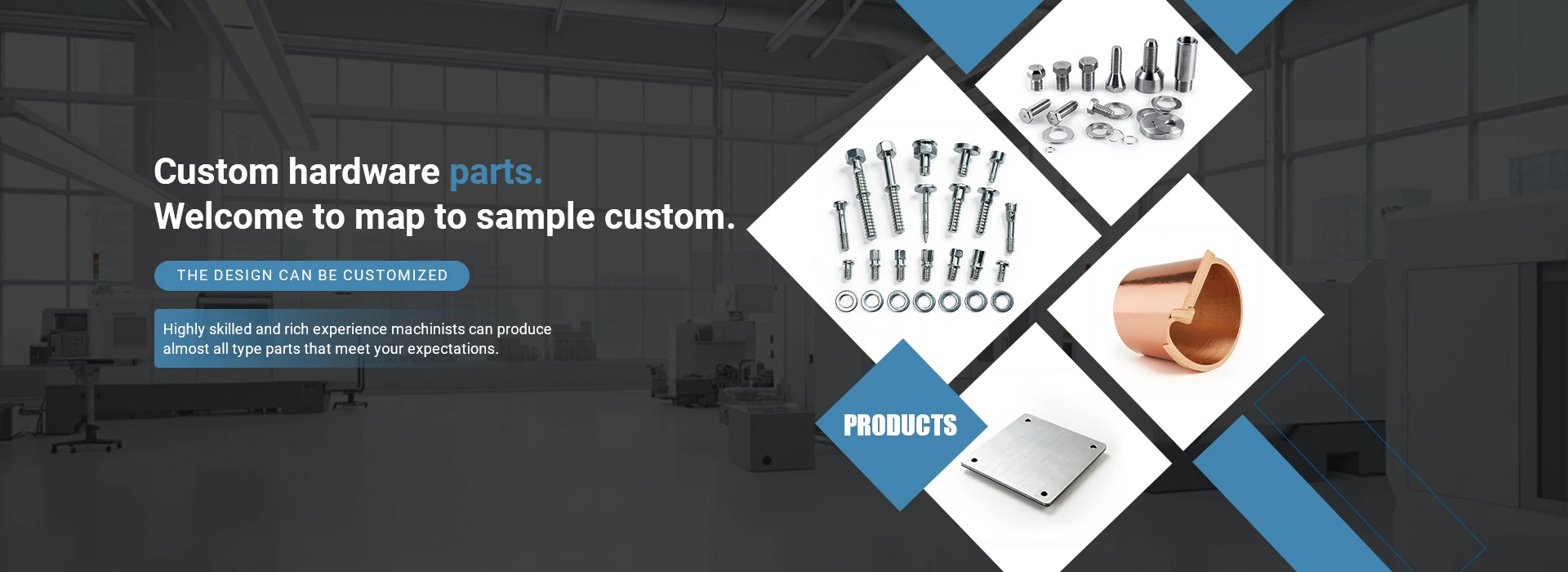
Sheet Customized Fasteners Service
High-performance custom bolts, nuts, screws, washers and rivets for commercial & industrial projects. Our Shenzhen 9,800 m² factory produces custom fasteners via cold heading, CNC turning, thread rolling and in-house plating.
Send your drawing or design file to get a DFM review and quote within 24 hours.
Custom fastener tolerances: standard ±0.10 mm, precision grades ±0.02 mm ~ ±0.05 mm.
Certifications: AS9100D, IATF 16949, ISO 14001, ISO 9001.
No MOQ available, covering prototype development to full mass production.


Fastener Manufacturing Capabilities
These specifications apply across all fastener manufacturing processes. Tighter tolerances and custom specifications are available on request with engineering review.
|
Feature |
Description |
|
Precision Tolerance |
±0.02–±0.05 mm |
|
Standard Tolerance |
±0.05–±0.10 mm |
|
Standard Lead Time |
Samples: 7–15 days; Mass production: 10–20 days |
|
Maximum Part Size |
Maximum specification ≤ M24 or length ≤ 1000 mm |
Fastener Materials
-
1.Carbon Steel
Type
Common Grades
Low Carbon
SAE 1006, 1008, 1010, 1018
Medium Carbon
SAE 1035, 1045
Alloy Steel
SAE 4140, 4340, 8620, 10B21
-
2.Stainless Carbon Steel
Type
Common Grades
Austenitic
304, 304L, 316, 316L, A2-70, A4-80
Martensitic
410, 416, 420
Duplex
2205
-
3.Brass and Copper
Type
Common Grades
Brass
C2600 (H65), C2680 (H62), C3600 (HPb63-3)
Copper
C1100 (T2), C1020 (TU1)
Bronze
Phosphor bronze C5191, Silicon bronze C65100
-
4.Specialty Alloys
Type
Common Grades
Aluminum
2024-T4, 6061-T6, 7075-T6
Titanium
Grade 2, Grade 5 (Ti-6Al-4V)
Nickel Alloys
Inconel 718, Monel 400, Hastelloy C276
Fastener Surface Finishes
We apply surface finishes in-house to control quality and lead time. Each finish below improves corrosion resistance, appearance, and fastener performance.
Description: Natural metal surface after manufacturing without additional coating.
Advantages: Low cost, simple processing
Typical Applications: General hardware, indoor applications
Description: Applies a thin zinc coating to steel fasteners for corrosion protection. Typical thickness: 5–25 μm.
Advantages: Good corrosion resistance, economical, decorative options
Typical Applications: Automotive, construction, general industrial fastening
Description: Fasteners are immersed in molten zinc to create a thicker protective layer.
Advantages: Excellent outdoor corrosion resistance, long service life
Typical Applications: Bridges, towers, marine structures, outdoor equipment
Description: Chemical conversion coating that creates a black protective surface layer.
Advantages: Improved appearance, reduced light reflection, minimal dimensional change
Typical Applications: Machinery, tools, precision fasteners
Description: Creates a porous phosphate layer that improves corrosion resistance and paint adhesion.
Advantages: Good lubrication retention, wear protection
Typical Applications: Automotive parts, industrial equipment
Description: Deposits a nickel layer on fasteners for corrosion resistance and appearance.
Advantages: Smooth finish, wear resistance, decorative appearance
Typical Applications: Electronics, automotive, decorative hardware
Description: Applies chromium coating for hardness and visual appearance.
Advantages: High wear resistance, excellent appearance
Typical Applications: Decorative components, high-wear application
Description: Chemical treatment removes free iron and restores the chromium oxide layer.
Advantages: Improves corrosion resistance without changing dimensions
Typical Applications: Medical, aerospace, food equipment
Description: Nickel coating deposited without electrical current for uniform coverage.
Advantages: Excellent corrosion resistance, consistent thickness
Typical Applications: Precision fasteners, chemical equipment
Description: Zinc and aluminum flake coating applied to steel fasteners.
Advantages: High corrosion resistance, heat resistance, no hydrogen embrittlement risk
Typical Applications: Automotive, aerospace, heavy equipment
Description: Fluoropolymer coating providing low friction and chemical resistance.
Advantages: Reduced friction, anti-seize properties
Typical Applications: Aerospace, oil & gas, high-performance applications
Description: Polymer coating applied electrostatically and cured by heat.
Advantages: Wide color selection, strong protection
Typical Applications: Structural fasteners, outdoor applications
Our Custom Fastener Manufacturing Services
We run end-to-end fastener manufacturing under one roof. Each process operates on dedicated production lines with full traceability from wire to finished part.

We manufacture high-volume bolts, screws and rivets with reliable dimensional accuracy using our fleet of 60+cold heading machines. Multi-stage cold heading completes forming for heads, shanks and recess features in one continuous operation, eliminating material removal. This manufacturing method cuts raw material waste and lowers unit part costs. Our cold heading service is ideal for production orders ranging from 10,000 up to 1,000,000+ pieces.

Equipped with 160+ CNC lathes and 60+ Swiss-type lathes, we machine custom fasteners featuring complex designs that cold heading cannot achieve. The process suits parts with tight tolerances, special thread forms, stepped shanks, cross holes and undercuts. Precision reaches tolerances of ±0.02 mm on diameters and ±0.05 mm on lengths.

Thread rolling generates threads via cold metal displacement, not cutting. Compared with cut threads, rolled threads retain continuous grain flow for enhanced strength and superior fatigue resistance. Our service supports metric threads (M1–M36) and imperial threads (#0-80 to 1-8 UNC), with standard tolerance classes of 6g and 2A respectively.

We provide internal thread forming for nuts and threaded inserts. Our CNC tapping and rotary tapping equipment manufactures internal threads covering metric sizes M1 to M36 and imperial specifications ranging from #0-80 up to 1-8 UNC.
Tapping operations achieve threads meeting Class 6H tolerance standards. Precision critical projects can opt for the tighter Class 4H tolerance grade. All tapped internal threads undergo full inspection using GO and NO-GO plug gauges to guarantee consistent quality.

We deliver professional in-house heat treatment to custom-tune the mechanical strength of all fastener products. Our full-spectrum thermal processing supports industry-standard strength specifications, including SAE J429 Grade 2, Grade 5, and Grade 8, as well as ISO property classes 8.8, 10.9, and 12.9.
Our comprehensive heat treatment processes cover quenching, tempering, carburizing, and induction hardening, catering to diverse strength and durability requirements for commercial and industrial applications. Every production batch undergoes strict hardness testing, with complete, traceable quality documentation provided for all orders.

Our in-house finishing services deliver reliable corrosion resistance for fasteners. Options: zinc plating, electroless nickel, hot-dip galvanizing, black oxide, Dacromet and chrome plating. Treatments meet ASTM F1941 and ISO 4042 standards. Salt spray test reports are provided for all orders.
Applications of the Fasteners
EV battery tray covers, motor end bells, inverter housings, and charging station enclosures in aluminum A380 and A356. Heat-treatable alloys available for structural battery components.
LED housings, street lamp heads, and architectural luminaire bodies in thin-wall aluminum A413 with powder coat or anodized finishes. Designed for heat dissipation and IP65-rated enclosure integration.
Magnesium AZ91D brackets and housings for avionics, drone airframes, and interior components where weight reduction matters. Castings supplied with material certs and traceability.
Transmission housings, engine brackets, pulley covers, and structural nodes in A380 aluminum. IATF 16949 production with PPAP Level 3 documentation on request.
Zinc and aluminum enclosures, heat sinks, and connector shells for audio, computing, and smart home devices. Thin-wall zinc die casting down to 0.5 mm with decorative plating options.
Housings and structural bodies for diagnostic instruments and surgical carts in aluminum A356. Parts supplied with passivated or painted finishes compatible with clinical cleaning protocols.
Motor shells, pump housings, and structural frames for washing machines, HVAC units, and small kitchen appliances. High-volume aluminum and zinc tooling amortized across 100,000-plus unit programs.
5G antenna housings, base station heat sinks, and fiber optic enclosures in thin-wall aluminum. Cast-in mounting features reduce secondary machining and assembly time.
Pump casings, gearbox housings, and valve bodies in aluminum A380 and brass C85400. Pressure-tight castings available with vacuum impregnation for hydraulic and pneumatic applications.
Why Choose Xinyeda Solution for Fasteners
We oversee every stage of custom fastener manufacturing, from wire drawing, cold heading and threading to heat treatment and surface finishing. Thanks to full vertical integration, we deliver shortened lead times, consistent batch-to-batch quality, and transparent factory-direct pricing free from intermediary broker markups.
Our Certifications


FAQs About Fasteners
-
1.How do I choose the right material for my fastener?
Choosing the right fastener material depends on the application requirements, including load capacity, corrosion resistance, operating temperature, weight limitations, and environmental conditions. Carbon steel and alloy steel are commonly used for general industrial applications due to their high strength and cost efficiency, while stainless steel provides excellent corrosion resistance for outdoor, marine, and chemical environments. Aluminum and titanium fasteners are ideal for lightweight applications such as aerospace and transportation, offering high strength-to-weight ratios. For extreme temperature or highly corrosive environments, nickel-based alloys such as Inconel provide superior performance. Selecting the proper fastener material ensures reliable clamping force, durability, and long-term performance in demanding applications.
-
2.What is a cold heading?
Cold heading (also known as cold forming or cold forging) is a high-speed metal forming process that shapes wire or rod materials into fasteners and precision components at room temperature using dies and punches. Unlike machining, which removes material, cold heading uses compressive force to reshape the metal, resulting in higher material utilization, improved grain flow, enhanced mechanical strength, and consistent dimensional accuracy. This process is widely used for manufacturing high-volume parts such as bolts, screws, nuts, rivets, pins, and automotive fasteners from materials including carbon steel, alloy steel, stainless steel, aluminum, and copper alloys. With excellent production efficiency, low material waste, and reliable performance, cold heading is an ideal solution for large-scale fastener and precision component manufacturing.
-
3.Can custom fasteners be plated or finished?
Yes, custom fasteners can be plated or finished to improve corrosion resistance, wear performance, appearance, and service life. The suitable surface treatment depends on the fastener material, application environment, and performance requirements. Common finishes include zinc plating, hot-dip galvanizing, nickel plating, chrome plating, black oxide, phosphate coating, zinc flake coating, and passivation for stainless steel fasteners. Specialized coatings such as PTFE/Xylan coatings can also be applied to reduce friction and improve chemical resistance. Surface treatments are widely used in industries such as automotive, aerospace, construction, marine, oil & gas, and industrial equipment to ensure custom fasteners maintain reliable performance under demanding operating conditions.
-
4.What materials can be used for custom fasteners?
Custom fasteners can be manufactured from a wide range of materials to meet different requirements for strength, corrosion resistance, temperature performance, weight, and environmental conditions. Common materials include carbon steel and alloy steel for high-strength applications such as automotive, construction, and industrial equipment; stainless steel (304, 316, 17-4 PH) for excellent corrosion resistance in marine, chemical, medical, and outdoor environments; aluminum alloys for lightweight applications; titanium alloys for aerospace and high-performance components requiring a high strength-to-weight ratio; and copper, brass, and bronze alloys for electrical conductivity, corrosion resistance, and specialized applications. For extreme temperature or highly corrosive environments, nickel-based alloys such as Inconel and Hastelloy are also available. Material selection is based on the fastener's load requirements, operating environment, industry standards, and expected service life.
-
5.What are the typical diameter and length ranges for custom fasteners?
The typical diameter and length ranges for custom fasteners depend on the manufacturing process, material, part design, and application requirements. Standard custom fasteners can generally be produced with diameters from M1 to M100+ (approximately 0.5 mm to 100 mm+) and lengths from 1 mm to 1000 mm or more. Small precision fasteners, such as those used in electronics and medical devices, may be produced in diameters below 1 mm, while heavy-duty bolts and studs for construction, energy, and industrial equipment can exceed 100 mm in diameter. Manufacturing methods such as cold heading, CNC machining, hot forging, and thread rolling allow customization of head styles, thread types, lengths, and special geometries to meet specific application requirements. For high-performance industries like aerospace, automotive, and oil & gas, fastener dimensions are typically optimized according to load capacity, installation space, and industry standards such as ISO, DIN, ASTM, and ASME.
-
6.What custom fastener manufacturing processes are available?
Custom fasteners can be manufactured using different processes depending on the required material, geometry, production volume, strength requirements, and dimensional accuracy.
Common manufacturing methods include cold heading (cold forging) for high-volume bolts, screws, nuts, and pins, offering excellent material efficiency and improved mechanical strength;
hot forging for large or high-strength fasteners requiring superior toughness;
CNC machining for low-volume prototypes and complex custom fastener designs with tight tolerances; thread rolling for producing strong, precise threads with improved fatigue resistance; thread cutting and tapping for specialized thread profiles; and stamping or forming for lightweight sheet metal fasteners.
Additional processes such as heat treatment, grinding, surface plating, and inspection can be combined to achieve the required performance, corrosion resistance, and quality standards for industries including automotive, aerospace, construction, medical, and industrial equipment.